



Connected technology is moving beyond simple device-to-device communication. Modern businesses are building intelligent ecosystems in which devices, software, networks, cloud platforms, and artificial intelligence work together to generate useful information and automate decisions. This transformation is creating new opportunities across manufacturing, healthcare, transportation, retail, finance, energy, and many other sectors.
The growing importance of connected systems is closely linked with the development of artificial intelligence, edge computing, IoT, advanced networks, and cloud infrastructure. Industry research increasingly points toward technology becoming more intelligent, autonomous, and integrated rather than operating as isolated tools. Wave Tech reflects this broader movement by emphasizing technology that can support smarter operations, stronger connectivity, and scalable digital growth.
Why Connected Technology Matters for Future Growth
Businesses once viewed connectivity primarily as a way to share information. Today, connected infrastructure can influence how companies produce goods, serve customers, monitor assets, manage employees, and respond to market changes. Sensors can collect operational information, cloud systems can process large datasets, and AI can identify patterns that would be difficult to discover manually.
This shift creates a more responsive business environment. Instead of waiting for equipment to fail or customers to report problems, organizations can increasingly identify warning signs in advance. Connected technology can therefore improve efficiency while supporting better decision-making. The objective is not simply to connect more devices but to create meaningful relationships between data, systems, people, and automated processes.
Key Connected Technology Trends to Watch
1. Artificial Intelligence Becomes More Connected
Artificial intelligence is becoming a central intelligence layer for connected ecosystems. Rather than functioning as a standalone application, AI can analyze information collected from sensors, customer platforms, enterprise software, machines, and other digital systems.
AI agents are also expected to become more useful in business environments by handling repetitive tasks and coordinating workflows. This can help employees spend more time on strategic and creative responsibilities. As AI becomes embedded into connected platforms, businesses can move toward faster analysis, personalized services, predictive maintenance, and automated decision-making.
2. IoT Moves Toward Intelligent Ecosystems
The Internet of Things remains one of the most important foundations of connected technology. Smart sensors and devices can continuously collect information about equipment, environments, vehicles, buildings, and consumer behavior.
However, the next stage of IoT is less about simply gathering data and more about interpreting it. When IoT devices are combined with AI and analytics, organizations can transform raw signals into practical insights. Wave Tech aligns with this evolution by highlighting the importance of connected systems that create measurable value instead of connectivity for its own sake.
3. Edge Computing Reduces Response Times
Cloud computing has transformed digital infrastructure, but sending every piece of information to a distant data center can create latency and bandwidth challenges. Edge computing addresses this issue by processing selected information closer to where it is generated.
This can be particularly valuable for autonomous machinery, smart factories, connected vehicles, security systems, and real-time monitoring. Faster processing can support quicker responses while reducing unnecessary data transfers. As connected environments expand, edge computing is likely to become an important complement to centralized cloud infrastructure.
4. Private 5G and Advanced Connectivity
Reliable connectivity is essential when thousands of devices need to communicate continuously. Private 5G networks can support industrial environments where organizations require low latency, controlled connectivity, and reliable device communication.
Advanced connectivity can help factories coordinate machines, warehouses track inventory, and organizations manage large sensor networks. Future network development will also support increasingly sophisticated connected applications, creating opportunities for businesses that require rapid data exchange.
5. Connected Technology and Cybersecurity
Greater connectivity also creates greater security responsibilities. Every connected device can potentially become part of an organization’s digital attack surface. As businesses add sensors, smart equipment, cloud platforms, and AI applications, security needs to become part of the architecture rather than an afterthought.
Modern approaches increasingly emphasize proactive security, stronger authentication, continuous monitoring, identity management, and automated threat detection. Wave Tech can contribute to future-ready thinking by recognizing that successful connected ecosystems must balance convenience and intelligence with strong digital protection.
Technology Trends and Their Business Impact
| Technology Trend | Business Opportunity | Main Advantage |
|---|---|---|
| AI and AI Agents | Workflow automation | Faster decisions |
| IoT | Real-time monitoring | Better visibility |
| Edge Computing | Real-time applications | Lower latency |
| Private 5G | Industrial connectivity | Reliable communication |
| Cloud Platforms | Scalable infrastructure | Flexible resources |
| Cybersecurity | Digital risk management | Greater resilience |
| Digital Twins | Simulation and optimization | Better planning |
| Robotics | Automated operations | Improved productivity |
Digital Twins Create Smarter Operations
Digital twins are another important development within connected technology. A digital twin creates a virtual representation of a physical object, machine, building, or process. Information from real-world systems can be used to update the digital model and help organizations understand how the physical environment behaves.
Manufacturers can use digital twins to study equipment performance before making physical changes. Cities can model infrastructure, while logistics companies can evaluate transportation processes. By combining connected sensors with analytics and simulation, businesses can identify potential improvements with less dependence on trial and error.
Connected Robotics Bring Intelligence Into the Physical World
Robotics is becoming increasingly connected with AI, sensors, computer vision, and cloud infrastructure. This combination allows machines to perform more sophisticated tasks in environments that previously required continuous human supervision.

Warehouses can use robots to move goods, factories can automate repetitive production activities, and businesses can explore autonomous inspection systems. The major opportunity comes from combining physical automation with intelligent software. Instead of robots simply following fixed instructions, connected systems can increasingly respond to changing conditions.
Cloud and Hybrid Infrastructure Support Scalability
Connected technology generates significant amounts of information, making scalable infrastructure essential. Cloud platforms provide businesses with flexible computing and storage resources, while hybrid approaches allow organizations to balance cloud services with local and edge processing.
This combination is becoming increasingly important as AI workloads grow. Some tasks may require powerful centralized infrastructure, while others need local processing for speed, privacy, or reliability. A flexible architecture allows organizations to select the most appropriate environment for different workloads.
Personalization Will Become More Important
Connected technology is also changing customer experiences. Smart systems can combine information from multiple touchpoints to understand preferences, behavior, and usage patterns. Businesses can then deliver more relevant recommendations, services, notifications, and support.
Personalization can create stronger customer relationships when it is implemented responsibly. However, organizations must be transparent about data collection and provide appropriate safeguards. Future growth will depend not only on how much information companies can collect but also on how responsibly they use it.
Sustainability Through Connected Systems
Connected technology can support sustainability by helping organizations understand and control resource consumption. Smart meters, connected sensors, intelligent building systems, and predictive analytics can reveal where energy, water, fuel, or materials are being wasted.
Manufacturers can monitor equipment efficiency, buildings can automatically adjust energy usage, and transportation companies can optimize routes. These applications demonstrate how digital transformation can support environmental objectives while potentially reducing operating costs.
How Businesses Can Prepare for the Connected Future
Organizations do not need to adopt every emerging technology at once. A stronger strategy begins with identifying business problems that could benefit from better connectivity and intelligence.
Companies can focus on:
- Identifying repetitive processes suitable for automation.
- Connecting valuable equipment and operational assets.
- Improving data quality before expanding AI projects.
- Building cybersecurity into connected infrastructure.
- Using cloud and edge computing according to workload requirements.
- Training employees to work effectively with intelligent systems.
- Measuring technology investments against clear business outcomes.
The most successful implementations are likely to be those that connect technology investments with practical objectives. Industry research in 2026 increasingly emphasizes moving from experimentation toward measurable impact, showing why technology strategy must focus on execution as well as innovation.
The Future Direction of Connected Technology
The next phase of connected technology will likely involve greater convergence. AI, IoT, robotics, edge computing, cloud platforms, advanced networks, and cybersecurity will increasingly operate as parts of the same ecosystem.
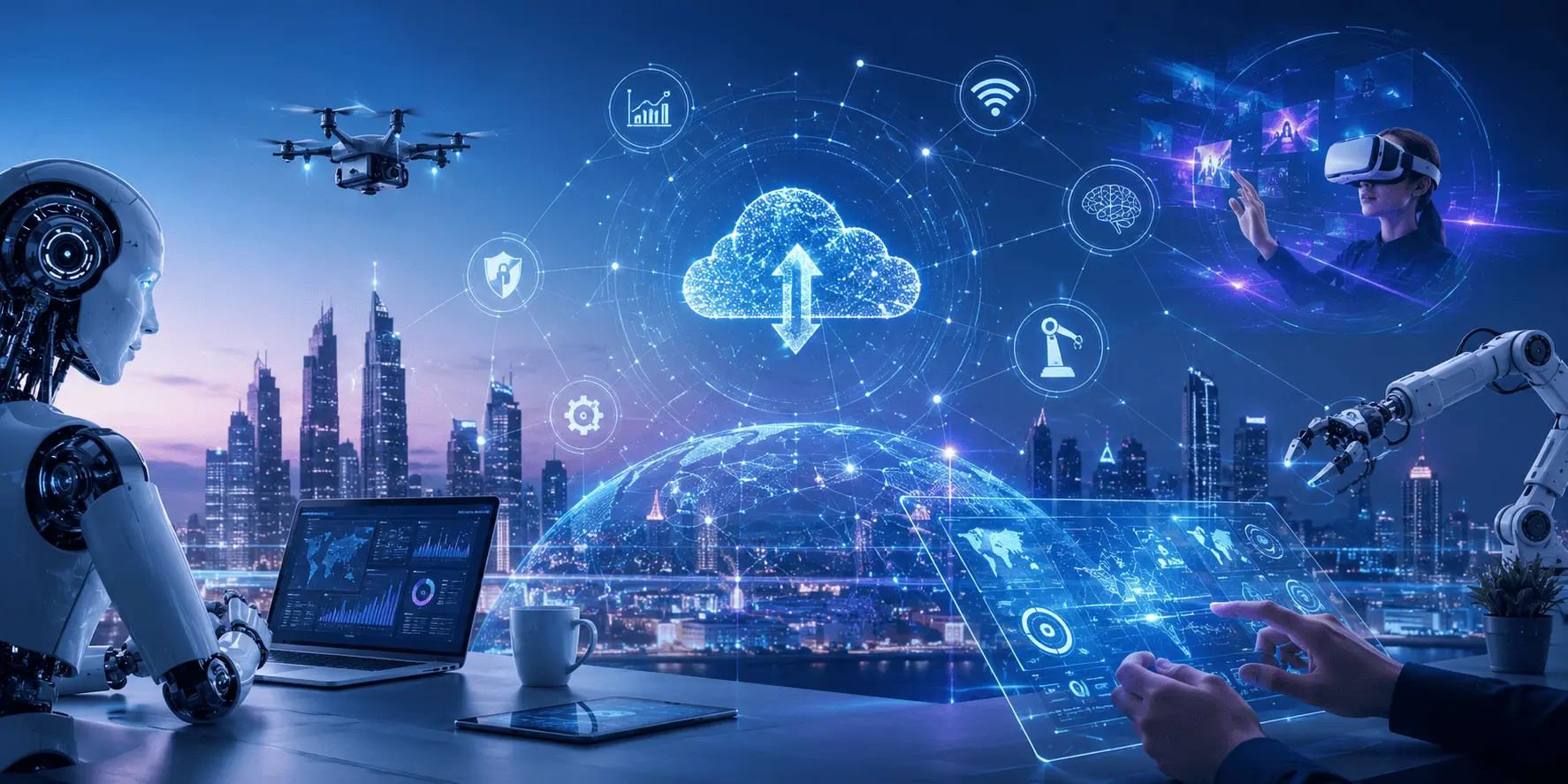
This convergence can create systems capable of sensing conditions, analyzing information, making recommendations, and taking action. The result could be more adaptive factories, smarter transportation networks, responsive buildings, intelligent logistics operations, and highly personalized digital services.
Wave Tech represents the broader opportunity presented by this convergence: using connected innovation to build systems that are faster, more intelligent, scalable, and adaptable. Future growth will depend on how effectively businesses turn these capabilities into useful outcomes.
Conclusion
Connected technology is becoming a foundation for modern business growth rather than an optional digital upgrade. AI is adding intelligence, IoT is expanding visibility, edge computing is improving responsiveness, advanced networks are strengthening connectivity, and cybersecurity is protecting increasingly complex ecosystems. The biggest opportunity lies in combining these technologies strategically. Businesses that focus on interoperability, reliable infrastructure, data quality, security, employee skills, and measurable results can create stronger foundations for long-term innovation.
As technology continues to evolve, Wave Tech can be viewed within a wider movement toward intelligent connected ecosystems. The organizations prepared to integrate emerging technologies thoughtfully will be better positioned to improve efficiency, create new services, respond to customers, and compete in an increasingly digital economy. The future of growth will not simply belong to businesses with more technology, but to those that connect technology with purpose.